Google AI Max: Avoiding the 'Black Box' Trap for Profitable Feed Optimisation
Google's AI Max promises set-and-forget. Without guardrails, you outsource margins to an algorithm that ignores your bottom line. How to use AI Max profitably.
Off Leesh Digital
Founder & Director, Off Leesh
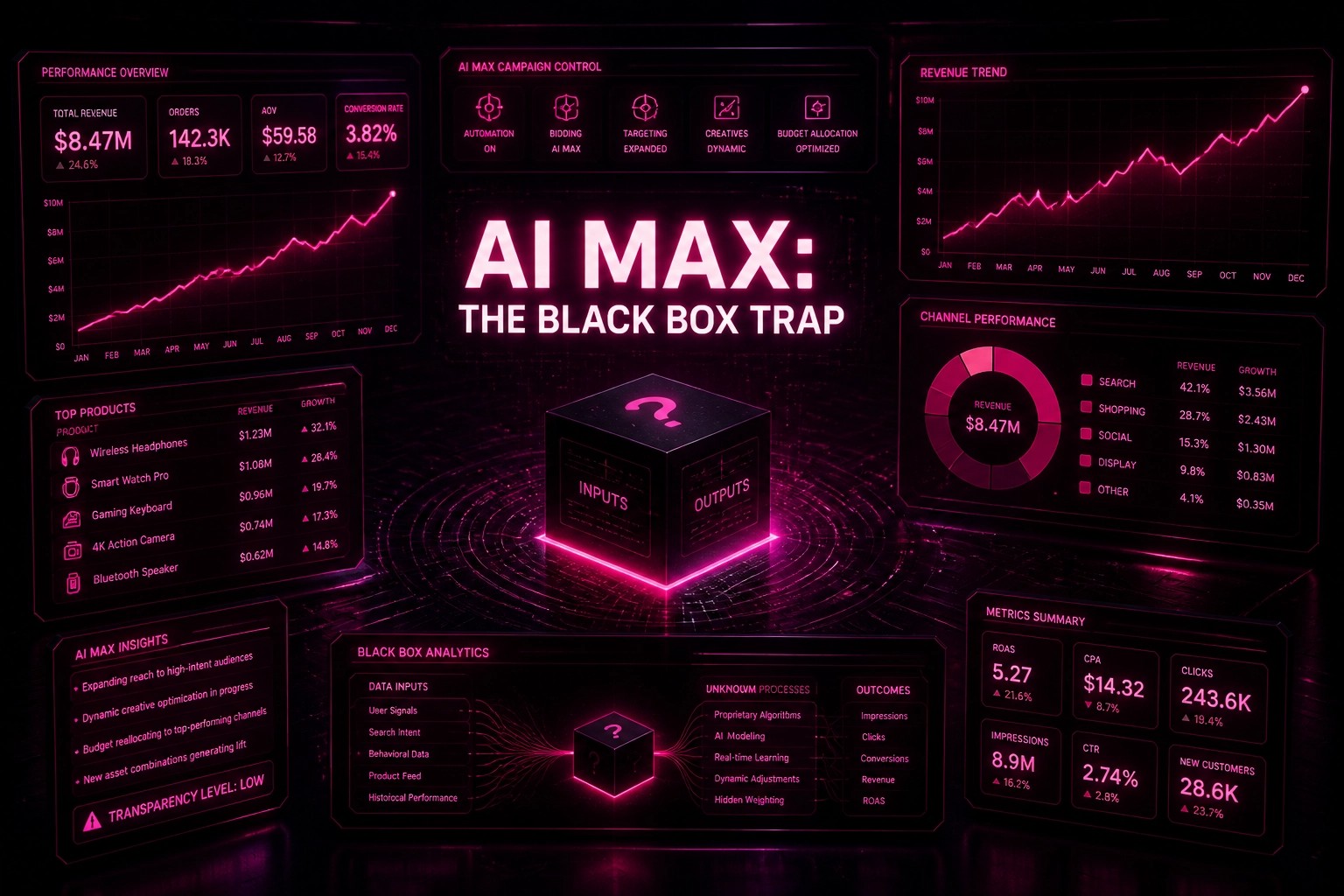
Google's marketing for AI Max is seductive. They promise a world where you simply "set and forget", letting their advanced machine learning find your customers, write your copy, and optimise your bids while you sit back and watch the revenue roll in. For an ecommerce director doing $50k or $100k a month, it sounds like the ultimate leverage.
But here's the reality: Google's AI is designed to do one thing exceptionally well: maximise Google's revenue.
When you hand over the keys to a "Black Box" like AI Max without proper guardrails, you aren't just leveraging AI — you're outsourcing your profit margins to an algorithm that doesn't care about your inventory levels, your COGS, or your net bottom line. At Off Leesh, we've seen enough "automated" accounts to know that "set and forget" is usually just code for "slowly bleed budget until you realise the ROAS is fake."
If you want to scale profitably in 2026, you need to stop treating AI Max as a magic wand and start treating it as a high-powered engine that requires expert tuning. Here is how we avoid the Black Box trap and maintain control over profitable growth.
The Illusion of Automation
The biggest problem with Google AI Max is the lack of transparency. When everything is automated — from the search terms you show up for to the creative assets being tested — you lose the ability to see why something is working (or why it isn't).
Google's "Search Term Expansion" is a classic example. On paper, it sounds great: finding semantically related queries to find more buyers. In practice, it often means your budget for high-intent keywords like "organic linen bed sheets" is being diverted to informational queries like "how to wash linen" or "best bedroom colours 2026." These clicks cost you money but rarely result in a sale.
Without the ability to easily exclude these low-intent terms or see exactly which products are triggering which ads, you are flying blind. This is the Black Box. And in the Black Box, your budget disappears into a void of "learning phases" and broad match experiments that prioritise volume over value.
Feed Control: The Real Lever for Growth
If you want to win with Google Ads, you have to realise that the algorithm is only as good as the data you feed it. Most agencies focus on the bidding strategy, but the real lever for ecommerce growth is Feed Optimisation.
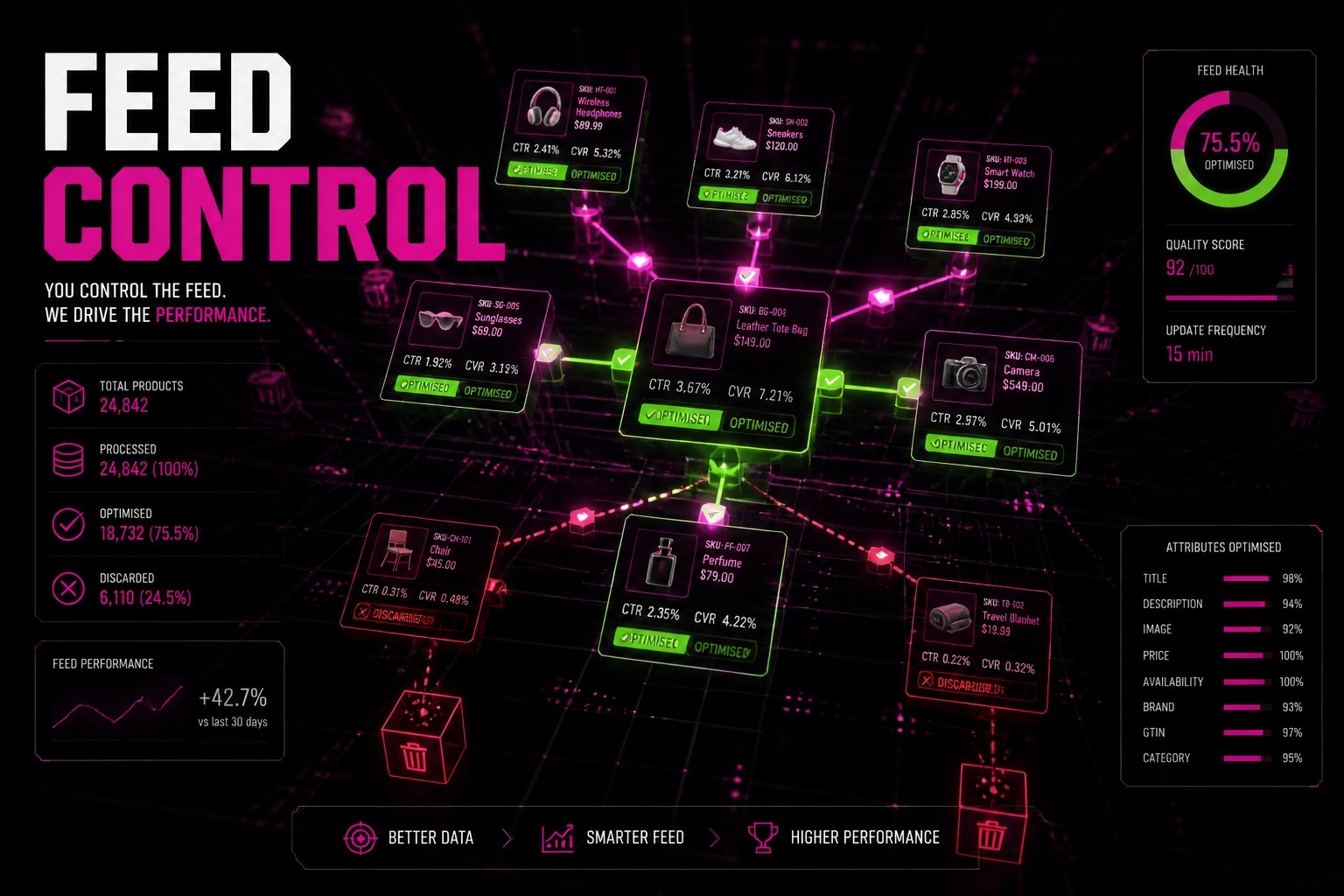
Your Merchant Center feed is the "source of truth" for AI Max. If your feed is sparse, your ads will be generic. If your product titles are just "Blue Shirt - Large," you are forcing the AI to guess who should see that ad.
We take a different approach. We don't let the AI guess. We provide it with surgical-grade data through:
- Title Optimisation: We restructure titles to follow the high-intent search patterns of your customers (e.g., Brand + Material + Key Feature + Product Type + Size/Colour).
- Attribute Completion: While most brands settle for the basics, we push for 99.9% attribute completion — GTINs, material, patterns, and custom labels.
- Custom Labelling: We categorise your products by performance, not just by type. We use custom labels to segment "Best Sellers," "High Margin," and "Zombie Products" (those that get clicks but no sales).
By taking control of the feed, you aren't just letting the algorithm run wild — you are giving it a map to your most profitable customers. You can read more about our deep-dive into Google Shopping management here.
Implementing Budget Guardrails
One of the most dangerous aspects of AI Max is its tendency to chase "cheap" conversions that don't actually move the needle. If you have a product at $20 and another at $500, the AI might spend 80% of your budget on the $20 item because it's easier to get a "conversion."
Without Budget Guardrails, your blended ROAS might look okay on paper, but your actual bank balance tells a different story.

At Off Leesh, we don't believe in "Maximise Conversions" as a default strategy. We use value-based bidding with strict Target ROAS (tROAS) floor limits. We go deeper on where automated bidding helps and where it hurts in our guide to AI Max and Smart Bidding. We also implement script-based monitoring that runs 24/7 to catch performance drops in real-time. If the algorithm starts wasting spend on a non-performing category, we don't wait for a weekly report to catch it. Our AI-powered analysis identifies the drain and shuts it down immediately.
This is the difference between a "set and forget" agency and a performance partner. We focus on cutting losers fast so we can double down on the winners. Our methodology for scaling ecommerce brands is built on this foundation of rigorous data-driven control.
Our AI vs. Their AI
It might seem ironic that an AI-driven agency is sceptical of Google's AI. But there is a massive distinction: Google's AI is built for their scale; our AI is built for your profit.
We use proprietary real-time analysis to:
- Identify Winning Audiences: We don't just rely on Google's "signals." We cross-reference your Shopify data to find the highest LTV (Lifetime Value) customers and feed that back into the ad accounts.
- Creative Strategy: We score your creative assets before they even go live. Using AI to analyse visual patterns that resonate with your specific niche, we cut out the guesswork of "will this work?" and replace it with "we know this scales."
- Automated Bidding Adjustments: While Google automates for volume, we automate for profitability. If your stock levels drop on a certain SKU, our systems automatically throttle back the spend to prevent wasted clicks on out-of-stock items. Learn more about why Shopify ads stall and how to fix it.
Scaling Without Losing the Leash
Scaling from $50k to $250k+ a month requires a shift in mindset. You can't just throw more money at a Black Box and hope for a linear return. In fact, that's usually where the "inconsistent ROAS" frustration begins.
To scale profitably, you need a partner who understands the nuances of Google Shopping vs. Performance Max and knows when to pull back from automation to regain manual control.
We don't work with just any brand. We only take on ecommerce companies where we know our data-driven, no-fluff approach can generate compounding growth. That's how we've managed to generate millions in revenue for our clients with an average revenue lift of +126%.
Is Your Account Trapped in the Black Box?
If you are currently running AI Max or Performance Max and you can't tell exactly which products are driving your profit — or if you feel like you're constantly fighting "inconsistent" results — you are likely trapped in the Black Box.
Google will keep taking your money as long as you let the algorithm run on autopilot. It's time to take the leash off your growth and put it back on your budget.
Stop guessing and start scaling. We offer a free account audit and strategy session for ecommerce brands doing $10k to $250k+ per month. We'll look under the hood of your AI Max campaigns, find the budget leaks, and show you exactly how to optimise your feed for actual profit. In the meantime, our list of 7 revenue-draining Google Ads mistakes covers the leaks we find most often. Not sure what to look for in a performance partner? Read our guide on 10 things to know before you scale.
Want results like this for your brand?
We run Google and Meta ads for ecommerce brands doing $10k–$250k+/month. Month-to-month, no lock-in, direct access to your strategist.