The Checkout is the Ad: How Universal Commerce Protocol (UCP) is Killing the 'Click' in 2026
For two decades the click was everything. In 2026, UCP builds checkout into the ad. What agentic commerce means for Shopify brands measuring Store Sessions.
Off Leesh Digital
Founder & Director, Off Leesh
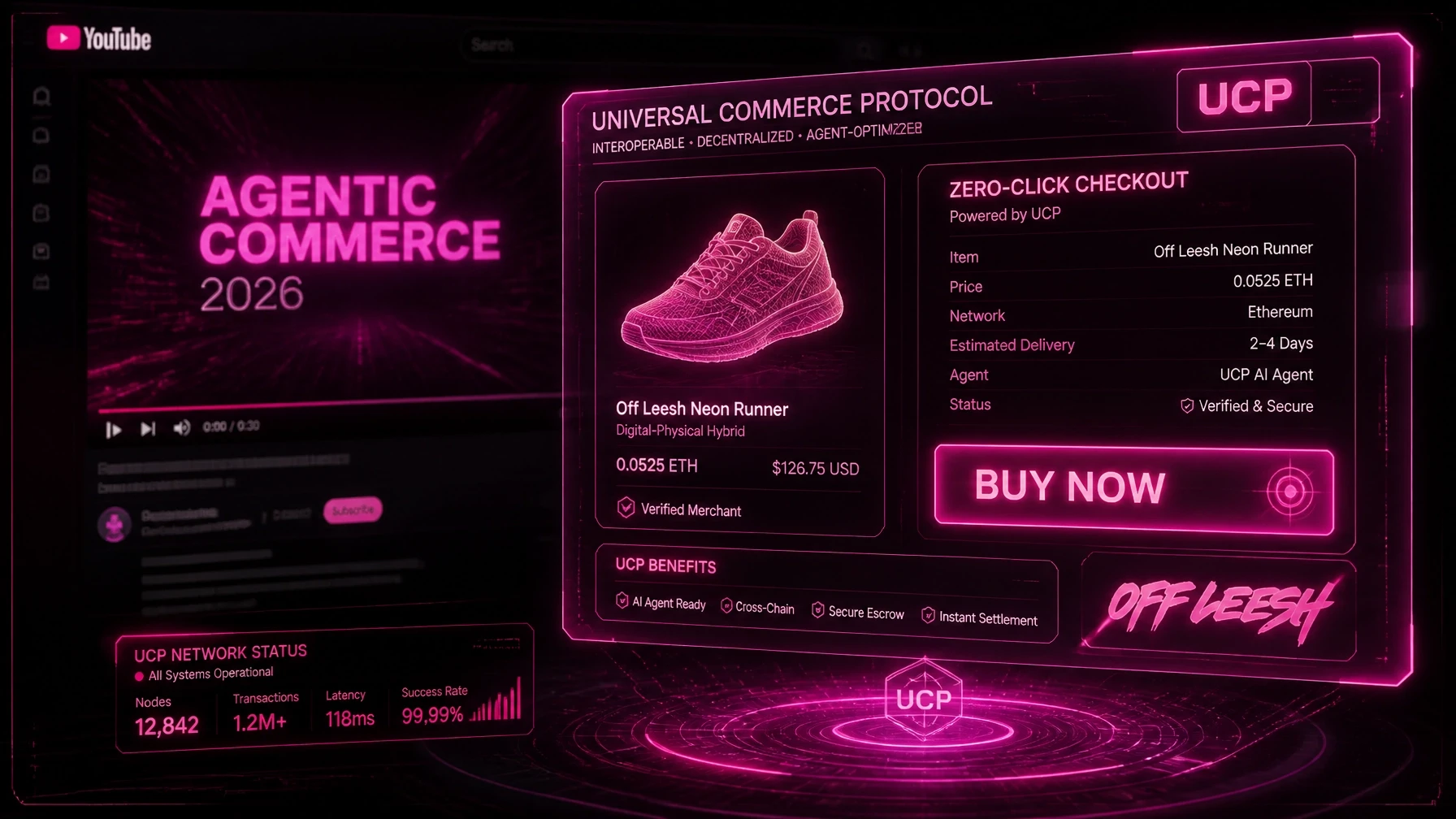
For the last two decades, the "click" was the holy grail of ecommerce. You ran an ad, you begged for a click, you sent them to your Shopify store, and you prayed your landing page was fast enough to stop them from bouncing.
In June 2026, that entire model is officially a relic.
Welcome to the era of Universal Commerce Protocol (UCP). This isn't just another update to Google's algorithm. It is a fundamental rewiring of how people buy things online. We are moving from "click-to-site" to agentic commerce, where the checkout isn't something that happens at the end of a journey. It is built directly into the ad itself.
At Off Leesh, we have been watching this shift coming since the first beta tests. If you're still measuring success based on Store Sessions, you're missing the fact that your next $100k in revenue might never even touch your Shopify front-end. For context on why blended measurement matters more than ever, read our guide on blended metrics for ecommerce brands.
What is UCP? (And Why Your Agency is Probably Scared of It)
Universal Commerce Protocol is an open-source standard co-developed by Google and Shopify. Its purpose is simple: to allow AI agents (like Gemini) and surfaces (YouTube, Search, Gmail) to handle the entire shopping journey, from discovery and configuration through to payment, without the user ever leaving the app.
Think of it as a "Universal Cart" that follows the user everywhere. They see a pair of sneakers in a YouTube video, tap a button, select their size (which Gemini already knows), and pay with a thumbprint. Done. No redirect. No 3-second load time. No "I'll come back to this later."
For a performance marketing agency, this is the ultimate test. You can no longer hide behind "good traffic" if the checkout is happening inside the ad. You either convert, or you don't.
The Rise of the Ghost Store
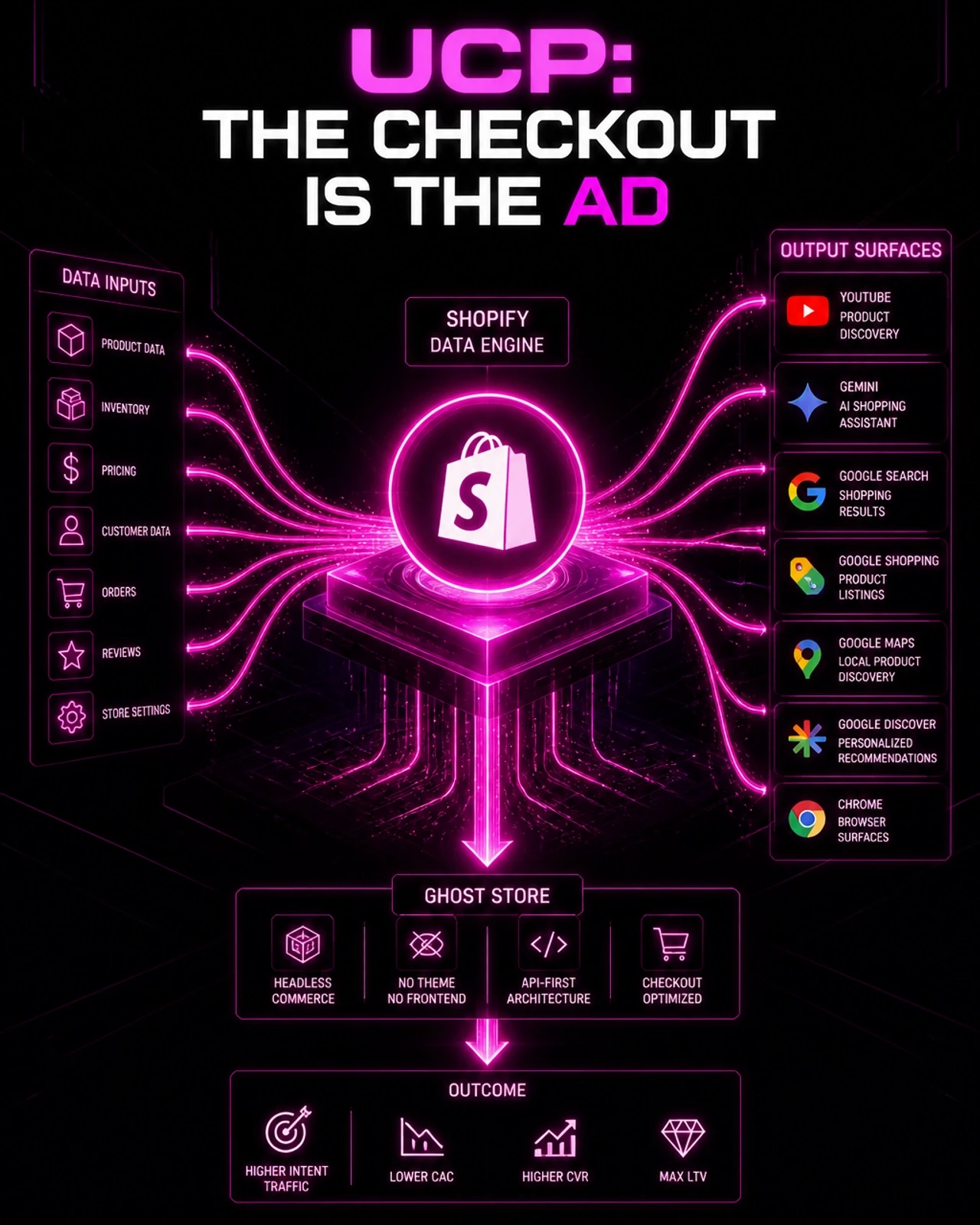
In 2026, your Shopify store is increasingly becoming a "Ghost Store." It is still the engine: it handles your inventory, tax, and fulfillment. But it is no longer the primary storefront.
The storefront is now everywhere:
- The Gemini App: Users ask their AI assistant to "find a waterproof hiking boot under $200," and the assistant uses UCP to build a cart and present a "Pay Now" option.
- YouTube "Buy" Buttons: Traditional YouTube advertising has evolved into direct-to-consumer transactions embedded in the video experience.
- Agentic Search: Google Search results now include live checkout modules that sync directly with your inventory.
If your ecommerce growth agency isn't talking to you about UCP integration, they are essentially trying to sell you a horse and carriage in the age of the Tesla.
Why Data Hygiene is the New Creative
Since the AI agent is the one doing the "shopping" for the user, it needs to understand your products perfectly. This is where most brands fail. If your product feed is a mess of generic titles and missing attributes, the AI agent will simply skip you.
UCP requires a level of feed optimisation that most "set-and-forget" agencies can't handle. We're talking about:
- Deep Metafields: Feeding the AI data on fabric, fit, occasion, and even sustainability scores so it can match your product to the right buyer query.
- Real-Time Inventory Sync: Because if an AI agent tries to checkout and your product is out of stock, you've just paid for a failed transaction.
- Cross-Surface Pricing: Ensuring your discounts are reflected accurately across every Universal Commerce Protocol surface. Read our breakdown of Google Shopping feed management for the technical detail.
Data-Driven Scaling: AI as Your Early Warning System
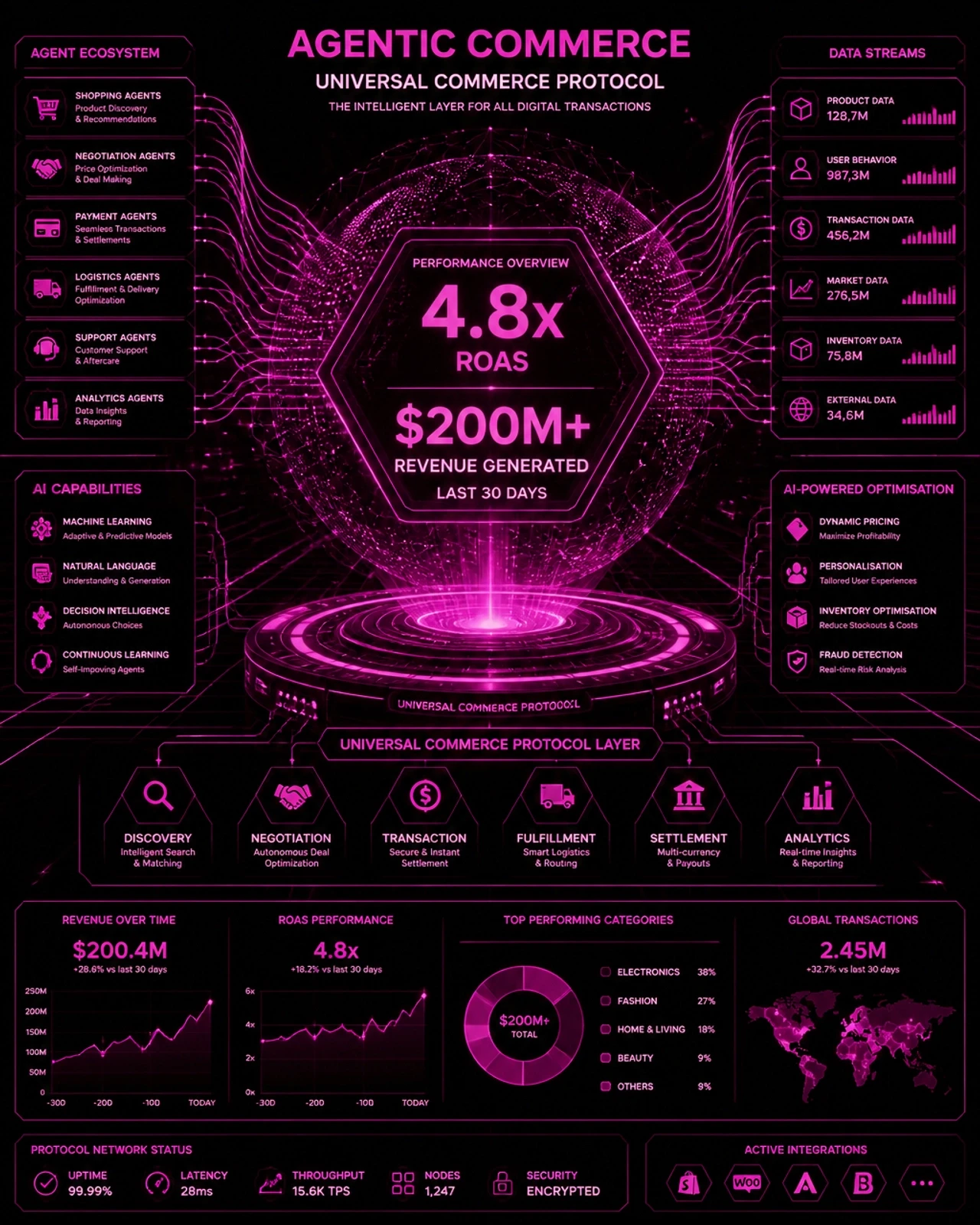
At Off Leesh, we don't believe in human guesswork. UCP creates huge volumes of cross-surface data, and that is exactly where AI-powered analysis is useful: not as some magic "always on" autopilot, but as a sophisticated diagnostic layer. We use AI to analyse massive data sets, spot patterns, identify emerging trends, and flag performance drops or broken elements before they turn into bigger revenue leaks.
We have generated millions in revenue for our clients with an average 4.8x ROAS. We didn't do that by following old-school funnel logic. We did it by using better data to cut the losers fast and scale the winning audiences that are ready for agentic commerce. For more on how we structure that process, see our post on scaling from $10k to $250k.
The Off Leesh Difference: No Leesh, No Fluff
Most agencies will try to confuse you with blended metrics and click-through rates to hide the fact that they don't understand how UCP works. They'll pass you off to a junior account manager who reads from a script.
We have a No Leesh policy. When you work with us, you get direct access to the experts who are actually pulling the levers in your account. No gatekeepers, no ticketing systems, and zero fluff. We only work with brands we know we can scale, typically those doing between $10k and $250k per month who are ready to take the training wheels off. You can read more about our approach in our guide to scaling to $250k.
Is Your Brand Ready for the Zero-Click Future?
The traditional funnel is dying. The "click" is being replaced by the "transaction." If you're a Shopify store owner, the Universal Commerce Protocol is either your biggest opportunity or your biggest threat. The brands that win will be the ones with clean data, agentic-ready feeds, and a partner who understands the new landscape.
If you're tired of inconsistent ROAS and agencies that are still living in 2024, it is time to level up. We'll audit your account, look at your feed hygiene, and tell you exactly where you're leaking revenue in this new UCP landscape.
Want results like this for your brand?
We run Google and Meta ads for ecommerce brands doing $10k–$250k+/month. Month-to-month, no lock-in, direct access to your strategist.