Google AI Max and Smart Bidding: The Pros, the Cons and the Reality Behind Automated Search
AI Max expands Search reach while Smart Bidding picks auctions. More reach with less manual work, but less control — and automation that scales bad data fast.
Off Leesh Digital
Founder & Director, Off Leesh

Google Ads is moving steadily towards a future where advertisers provide the business objective, creative inputs and conversion data, while Google's artificial intelligence determines who to reach, which searches to enter, what message to display and how much to bid.
AI Max for Search campaigns represents one of the largest steps in that direction.
Rather than replacing traditional Search campaigns, AI Max acts as an optimisation layer within them. It expands targeting beyond an advertiser's existing keyword list, dynamically adjusts ad copy, selects landing pages and works alongside Smart Bidding to determine which opportunities are likely to produce conversions or conversion value.
The promise is compelling: more reach, more relevant ads and better performance with less manual work.
The trade-off is equally important: less direct control, greater dependence on Google's models and a heightened risk that weak conversion data will lead the system towards the wrong outcomes. We explored the transparency side of this in our guide to the AI Max black box.
So, is AI Max the future of Google Search advertising, or simply another layer of automation advertisers need to keep under control?
How AI Max and Smart Bidding work together
AI Max and Smart Bidding perform different but closely connected jobs.
AI Max influences where and how an advertiser can appear. Its main components include:
- Search term matching that uses broad match and keywordless technology.
- Text customisation that creates new ad assets from existing ads, keywords and website content.
- Final URL expansion that can send users to a page Google predicts is more relevant than the advertiser's nominated landing page.
- Brand, location and URL controls designed to guide where the automation can operate.
Smart Bidding determines whether an eligible auction is worth entering and how much Google should bid.
Google's Smart Bidding strategies include Maximise Conversions, Target CPA, Maximise Conversion Value and Target ROAS. Bids are calculated at auction time using signals including the actual search query, device, physical location, location intent, time of day, browser, operating system, remarketing-list membership and the ad variation being served.
In simple terms, AI Max increases the number of potential opportunities available to a campaign. Smart Bidding then attempts to identify which of those opportunities are likely to achieve the campaign's conversion or revenue objective.
This relationship is important. AI Max's search term matching does not operate fully with Manual CPC because it relies on signals generated through automated conversion-based bidding.

The advantages of AI Max and Smart Bidding
1. Greater reach beyond traditional keyword lists
One of AI Max's strongest benefits is its ability to identify relevant searches that an advertiser may not have explicitly targeted.
Traditional Search advertising requires marketers to anticipate how potential customers will describe their needs. That becomes increasingly difficult as searches become longer, more conversational and more specific.
AI Max uses existing keywords, ads, landing pages and website content as signals. It can then match ads to relevant queries through both broad-match expansion and keywordless matching.
For example, a brand bidding on "red midi dress" may have previously missed searches such as "colourful dresses for an outdoor spring wedding". AI Max can interpret the broader intent, determine whether the product is relevant and adapt the advertisement accordingly.
This creates a meaningful opportunity for businesses that have reached the limits of their current keyword coverage.
2. More sophisticated bidding at the individual-auction level
A human advertiser can adjust bids for devices, locations, schedules and audiences. However, it is effectively impossible for a person to calculate the ideal bid for every possible combination of signals in real time.
Smart Bidding can assess each auction individually.
Two people may enter the same search query but receive very different bids based on their location, device, previous website interactions, time of day and predicted likelihood of converting.
This is where automated bidding is generally stronger than manual bidding. It is not simply increasing or reducing a keyword bid. It is estimating the potential value of a specific user, in a specific context, at a specific moment.
For larger accounts with sufficient conversion volume, this can produce more accurate and efficient bidding than a fixed keyword-level CPC.
3. Better alignment between the search, ad and landing page
AI Max does not only expand targeting.
Text customisation can create headlines and descriptions that more closely reflect an individual user's search. Final URL expansion can then send that user to the page Google predicts is most relevant to their intent.
Google describes this as creating a more connected journey between the query, advertisement and landing page.
For businesses with large websites, extensive service categories or thousands of products, this can reduce the amount of manual campaign construction required. It may also uncover effective combinations that an advertiser would not have created independently. If your product data is the weak link, our Google Shopping feed guide covers how to strengthen it.
4. Faster scaling and reduced manual workload
AI Max can reduce the need to continually build keyword lists, create individual ad variations, select landing pages and make manual bid adjustments.
That does not eliminate the role of a PPC specialist. It changes where that specialist should spend their time.
Less time may be required for repetitive bid and keyword management. More time should be spent on:
- Conversion measurement.
- Commercial targets.
- First-party data.
- Search-term quality.
- Landing-page experience.
- Brand controls.
- Profitability and incrementality.
For smaller teams, this automation can provide access to optimisation capabilities that would otherwise require significantly more management time.
5. More reporting and controls than earlier automated products
AI Max still reduces direct control, but Google has introduced more visibility than advertisers received during the early rollout of products such as Performance Max.
AI Max reporting can show whether a search was generated through broad-match expansion or keywordless matching. It can also combine the search term, generated headline and selected landing page, allowing advertisers to evaluate the complete journey produced by the system.
Advertisers can also use:
- Brand inclusions and exclusions.
- URL inclusions and exclusions.
- Ad-group-level search term matching controls.
- Locations-of-interest settings.
- Search-term match-source reporting.
These controls make AI Max more governable than a completely closed system, although using them effectively still requires active management.
6. It prepares advertisers for Google's future direction
AI Max is no longer a temporary experiment. Google states that it is moving out of beta and will become the next generation of Dynamic Search Ads.
Campaigns using Automatically Created Assets or the campaign-level broad-match setting are scheduled to begin moving into AI Max from September 2026. Google has extended the Dynamic Search Ads transition, with its sunset and automatic upgrade now scheduled to begin in February 2027.
Advertisers do not need to enable AI Max across every campaign immediately. However, understanding and testing it is becoming increasingly important as Google consolidates more Search functionality within the system.
The disadvantages of AI Max and Smart Bidding
1. Automation amplifies the data it receives
The greatest risk is not necessarily the AI itself. It is the conversion data being supplied to it.
Smart Bidding optimises towards the conversion actions and values that an advertiser defines. It does not inherently understand whether a lead was qualified, whether a customer returned an order or whether a sale produced a healthy margin.
If a lead-generation campaign counts every form submission equally, Google may learn to generate the cheapest forms rather than the best potential customers.
If newsletter subscriptions, phone-button clicks and completed sales are all treated as primary conversions, Smart Bidding may favour whichever action is easiest to produce.
AI Max can then increase the scale of this problem by expanding into more queries.
More conversions do not automatically mean better commercial performance. Businesses need accurate revenue data, offline conversion imports, qualified-lead tracking or meaningful conversion values before giving the system greater freedom. This is exactly why we lean on blended metrics rather than platform-reported numbers alone.
2. Advertisers surrender some control over searches, messaging and landing pages
With AI Max enabled, keywords become signals rather than absolute boundaries.
Google can decide which additional searches are relevant, generate new text and select different pages from the advertiser's website.
Controls exist, but this is still a significant philosophical change from traditional Search advertising.
There are also practical consequences. When final URL expansion selects a different landing page, pinned responsive-search-ad assets may not be respected. Google also warns that incompatible tracking templates can produce broken dynamic landing pages or 404 errors.
This can create problems for advertisers operating in regulated industries, businesses with strict promotional disclaimers or brands that require exact control over how products and services are described.
Automatically generated copy should therefore be reviewed rather than assumed to be accurate or compliant.
3. Incrementality can be difficult to prove
AI Max may report additional conversions, but advertisers still need to determine whether those conversions are genuinely incremental.
The system can overlap with broad match, Dynamic Search Ads, Performance Max and existing exact- or phrase-match traffic. In some cases, it may capture searches that another campaign would have converted anyway.
This is particularly important for branded searches.
Brand traffic is usually highly efficient because the user is already familiar with the business. Allowing AI Max or another automated campaign to absorb that traffic can make the automated system appear more effective without necessarily generating additional demand.
Google's reporting provides greater visibility into AI Max traffic, but determining whether conversions were newly created or simply moved between campaigns remains difficult.
4. Incremental conversions may cost more
Google initially reported that advertisers activating AI Max could typically generate 14% more conversions or conversion value at a similar CPA or ROAS, with higher improvements in campaigns primarily using exact and phrase match. More recently, Google reported that enabling the complete AI Max feature set produced an average 7% improvement compared with using search term matching alone. These figures are based on Google's internal data and should not be interpreted as guaranteed account-level results.
Independent findings have been more variable.
Smarter Ecommerce analysed more than 250 AI Max Search campaigns and reported a median 13% increase in conversion value. However, those additional conversions carried a median CPA 16% higher than the campaigns' existing traffic. Median ROAS was broadly unchanged, while individual results ranged from 42% above the baseline to 35% below it, as also covered by Search Engine Land.
This does not necessarily mean AI Max is ineffective.
The first conversions captured by a mature campaign are generally the easiest and cheapest. Reaching additional customers usually requires entering less certain or more expensive auctions. The relevant question is therefore not whether AI Max traffic is as efficient as a brand's best exact-match keywords.
The question is whether the additional conversions remain profitable after advertising costs, fulfilment costs, margins and customer value are considered.
5. Smart Bidding needs sufficient data, budget and time
Google notes that AI Max is unlikely to work effectively when a campaign is limited by budget.
Smart Bidding also requires enough conversion data to identify meaningful patterns. Google currently requires Search campaigns to have at least 15 conversions within 30 days to use Target ROAS, and recommends allowing new conversion values to accumulate for several weeks or multiple conversion cycles before moving to value-based bidding.
Changes to conversion goals or actions can require another one to two conversion cycles of learning.
For low-volume businesses, this creates a challenge. The algorithm may not have enough reliable information to separate high-value opportunities from statistical noise.
Automation can still be tested in smaller accounts, but expectations should be realistic. Limited data, restrictive targets and constrained budgets can prevent the system from learning effectively.
6. Smart Bidding can achieve the platform target while missing the business target
Google Ads may show an acceptable CPA or ROAS while the business experiences deteriorating lead quality, declining profit or a higher percentage of returning customers.
This occurs because the platform can only optimise towards the information it receives.
For example, a Target ROAS campaign may favour high-revenue products even when those products have lower margins. A Target CPA campaign may find inexpensive leads that rarely progress through the sales process. A campaign optimising towards purchases may concentrate on existing customers because they are easier to convert.
The algorithm may technically be succeeding while the broader business outcome is getting worse. This is one of the most common and expensive Google Ads mistakes we see.
Google Ads performance therefore needs to be compared with CRM data, new-customer acquisition, contribution margin, qualified-lead rates and total business revenue.
Smart Bidding Exploration adds another growth lever
Smart Bidding Exploration is an additional feature available to qualifying Search campaigns using Target ROAS.
It does not expand the searches a campaign is eligible to match. Instead, it gives the bidding system more flexibility to pursue less obvious searches within the campaign's existing eligibility.
Google reported that Search campaigns using Smart Bidding Exploration produced 27% more unique converting users on average during an internal study conducted in early 2026.
The opportunity is greater traffic diversity and access to searches the system may previously have avoided because they were less predictable.
The risk is that advertisers are deliberately accepting more ROAS flexibility to pursue marginal growth. This may be appropriate for a business focused on expansion, but less suitable for one operating under strict profitability or cash-flow requirements.
Who should consider testing AI Max?
AI Max is most likely to benefit advertisers that have:
- Reliable conversion and revenue tracking.
- Sufficient conversion volume.
- Healthy campaign budgets.
- Well-structured websites and landing pages.
- Strong negative-keyword and brand-exclusion systems.
- A commercial need to find incremental growth.
- The ability to measure lead quality or revenue outside Google Ads.
It may be particularly useful for advertisers with large websites, complex product or service ranges, and established Search campaigns that have begun to reach the limits of their current keyword coverage.
Who should approach it cautiously?
AI Max may be unsuitable, or at least premature, when:
- Conversion tracking is incomplete or inaccurate.
- Campaigns optimise towards shallow actions.
- Sales quality is not reported back to Google.
- Budgets are consistently limited.
- Search volume is extremely low.
- Advertising claims require strict legal approval.
- Landing pages contain outdated or conflicting information.
- The business cannot tolerate short-term volatility.
- Existing brand and generic traffic cannot be separated clearly.
Defensive brand campaigns also require caution. A tightly controlled exact-match brand campaign may have little to gain from additional query expansion, especially if its primary purpose is to protect brand visibility at a predictable cost.
The right way to test AI Max
AI Max should not be activated across an entire account based solely on a Google recommendation.
A more responsible approach is to run a controlled experiment.
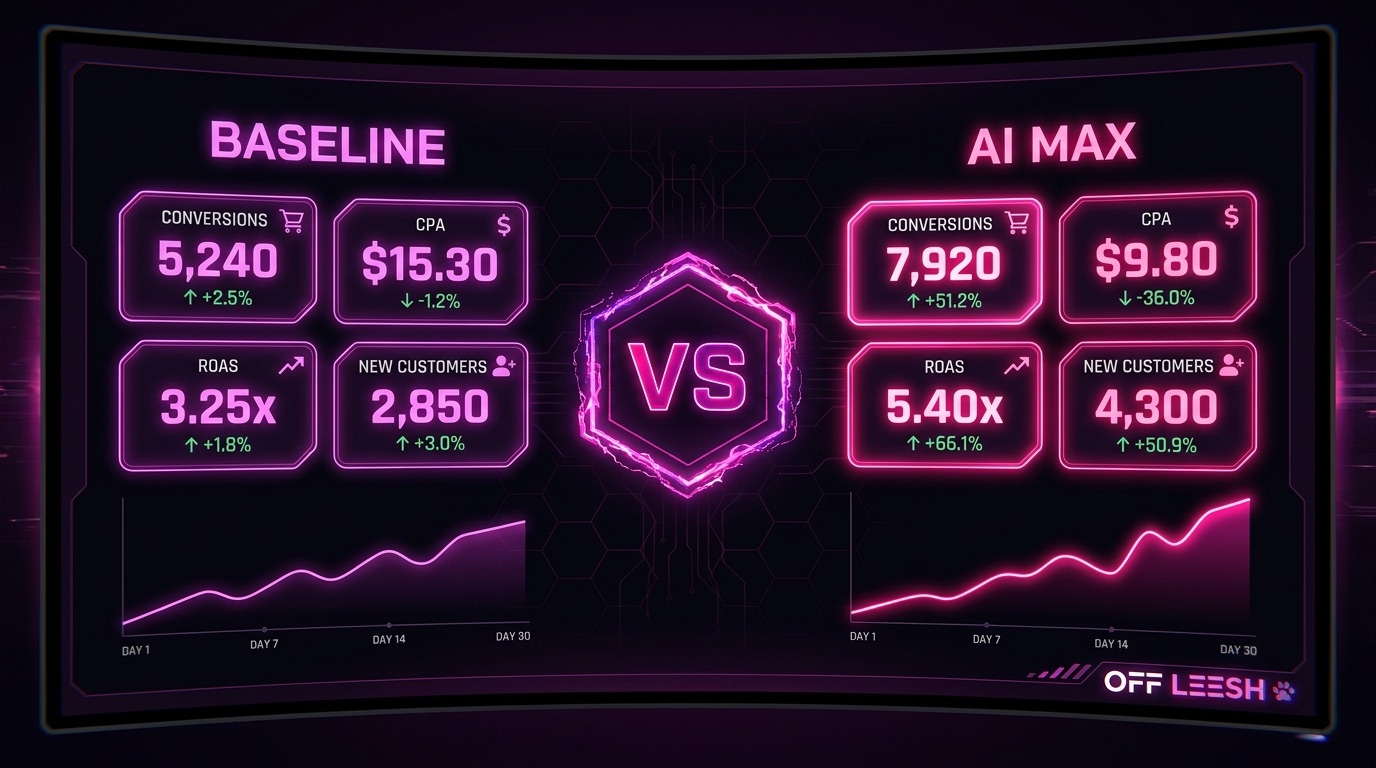
Select a campaign with dependable conversion data and sufficient volume. Establish clear baseline metrics before the test begins, including conversion volume, CPA, conversion value, ROAS, new-customer percentage and lead quality.
Where possible:
- Use a formal Google Ads experiment rather than a simple before-and-after comparison.
- Exclude the business's own brand from generic expansion campaigns.
- Review AI Max broad-match and keywordless traffic separately.
- Audit search terms, generated headlines and selected landing pages.
- Confirm that URL expansion is not sending traffic to irrelevant or outdated pages.
- Measure results using CRM, Shopify or backend revenue data rather than Google Ads alone.
- Evaluate performance over several conversion cycles.
- Scale only when the additional conversions are genuinely profitable.
The kind of continuous, signal-level monitoring this requires is where AI-powered real-time analysis earns its place.
The test should answer one central question:
Did AI Max generate valuable demand that the existing campaign would not have captured?
An increase in conversions is not enough if those conversions were cannibalised from another campaign, generated from existing customers or produced leads that never became revenue.
The verdict
AI Max and Smart Bidding are powerful, but they are not autonomous marketing strategies.
They are optimisation systems.
When supplied with accurate conversion data, realistic business targets, sufficient budget and appropriate controls, they can process more signals, test more opportunities and make faster auction-level decisions than a human advertiser could manage manually.
When supplied with poor data or vague goals, they can scale inefficiency with equal speed.
The future of Google Ads is unlikely to involve a return to completely manual keywords and bidding. Google is clearly moving towards intent-based matching, automated creative and real-time predictive bidding.
The role of the advertiser is therefore changing.
Success will depend less on manually adjusting every keyword bid and more on controlling the environment in which Google's AI operates. That means defining the right conversions, importing business-quality data, protecting brand traffic, setting profitable targets and independently validating whether reported performance translates into genuine growth.
AI Max should not be blindly accepted or automatically rejected.
It should be tested, constrained and judged against the commercial outcomes that matter beyond the Google Ads interface.
If you want a team that runs Google's automation with proper guardrails instead of handing it the keys, see how we manage Google Ads or book a free audit and we will show you exactly where your account stands.
Want results like this for your brand?
We run Google and Meta ads for ecommerce brands doing $10k–$250k+/month. Month-to-month, no lock-in, direct access to your strategist.