The YouTube Performance Pivot: Turning Creator Influence into Measurable Sales
YouTube is not your closer — it is your wingman. Treat it as standalone ROAS and you write it off too early. Use it to make Google and Meta spend work harder.
Off Leesh Digital
Founder & Director, Off Leesh
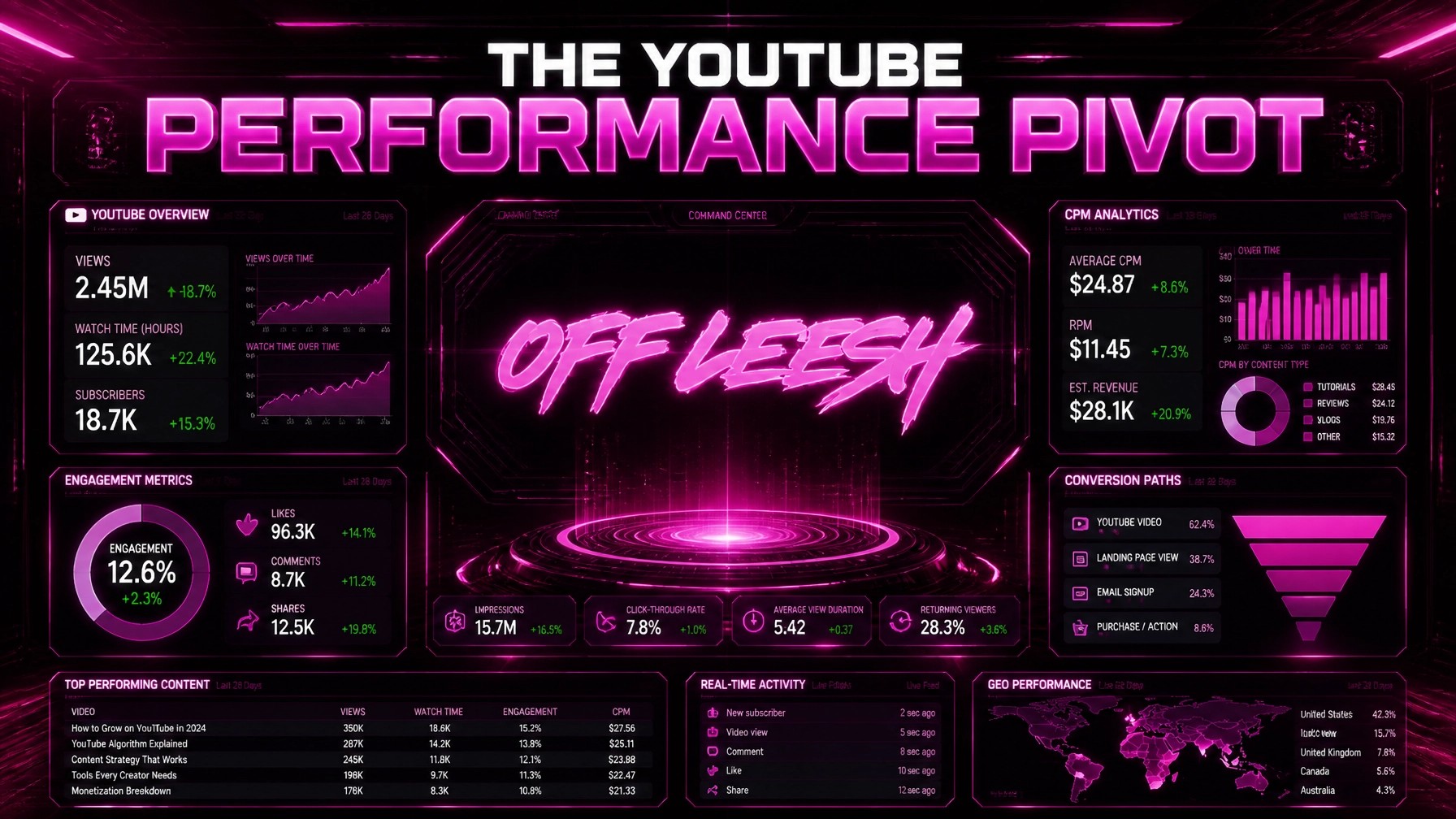
In the world of ecommerce, YouTube has long been the "expensive giant." For years, brands doing $10k to $250k+ a month have viewed it as a luxury: a place for "brand awareness" that did not necessarily move the needle on this month's revenue.
But as we move through 2026, a massive shift has occurred. The YouTube Performance Pivot is no longer a theory. It is a technical reality. Thanks to the integration of Gemini-powered AI and a fundamental change in how bidding algorithms treat the customer journey, YouTube is transforming into a high-octane performance engine.
However, there is a catch. If you treat YouTube as a "set and forget" standalone channel, it will bleed your budget dry.
That is where most brands get stuck. They look at YouTube in isolation, judge it on a narrow ROAS number, and switch it off before it has a chance to do the job it is actually best at doing: creating demand that your other channels can capture.
This is the key idea: YouTube is not your closer. It is your wingman.
If you expect cold YouTube traffic to behave like branded Search traffic, you are going to think the channel is broken. It is not. Your measurement model is. The brands that win with YouTube in 2026 are the ones that understand the difference between demand generation and demand capture, then build their ad account structure around both.
At Off Leesh, we have generated millions in revenue across ecommerce accounts with an average 4.8x ROAS, and one of the biggest patterns we see is this: brands stop growing when they rely too heavily on bottom-of-funnel channels alone. Search and retargeting can capture existing intent, but they do not manufacture enough fresh intent by themselves. At some point, you need something upstream to create attention, trust, branded search, and consideration. That is where YouTube earns its spot.
And if you want to measure this properly, you need to stop obsessing over one platform's dashboard ROAS and start paying attention to broader business metrics like aMER, especially New Customer MER. If your YouTube spend helps bring in new customers who later convert through Search, Shopping, Performance Max, or Meta, last-click ROAS will under-report the real impact. aMER gives you a more honest picture of whether your ad spend is producing profitable revenue across the whole account, not just inside one silo. For a deeper look at why blended measurement matters, read our guide on blended metrics for ecommerce agencies.
The Standalone Trap: Why Your YouTube ROAS is Flatlining
Most ecommerce directors fall into the "branding trap." They hire a creator, post a high-production video, and wait for the sales to roll in. When the ROAS comes back at a dismal 0.8x, they conclude that "YouTube does not work for us."
Here is what actually happens:
- You spend money on YouTube.
- You look at the platform report.
- You see weak direct return.
- You kill the campaign.
- Three weeks later your branded search volume softens, Meta retargeting gets less efficient, your Shopping CPA creeps up, and nobody connects the dots.
That is what single-channel thinking does. It makes upstream channels look bad and downstream channels look smarter than they really are.
Why single-channel attribution fails
Most ad platforms are still heavily biased towards the last measurable click or the most obvious conversion touchpoint. That creates three big problems for ecommerce brands:
- It over-values capture channels. Search, Shopping, branded terms, and retargeting often get the credit because they show up closer to purchase. They are important, but they usually close demand that was created earlier.
- It under-values influence channels. YouTube often changes buyer behaviour before the click ever happens. Someone sees a creator use your product, watches a review, remembers the brand, and later searches for you directly or clicks a Meta retargeting ad. The influence was real. The attribution trail is just incomplete.
- It encourages bad budget decisions. If you only fund what looks good in-platform, you end up starving the channels that create future demand. Short term, your dashboard may look cleaner. Medium term, growth stalls.
A simple example: someone watches 60 seconds of your YouTube ad on Monday. On Wednesday they Google your brand, click a Search ad, browse products, and leave. On Friday they see a Meta carousel retargeting ad and buy. If you use a lazy reporting model, Meta gets the credit. Maybe Search gets some. YouTube gets ignored. But without the YouTube touchpoint, the user may never have entered your orbit in the first place.
The real question is not "Did YouTube close the sale?" The better questions are: Did YouTube increase branded search? Did it lift click-through rates on Search or Shopping? Did it improve Meta retargeting conversion rates? Did new customer revenue grow? Did account-wide aMER stay healthy as spend increased?
The 2026 Tech: AI Creator-Matching and Journey-Aware Bidding
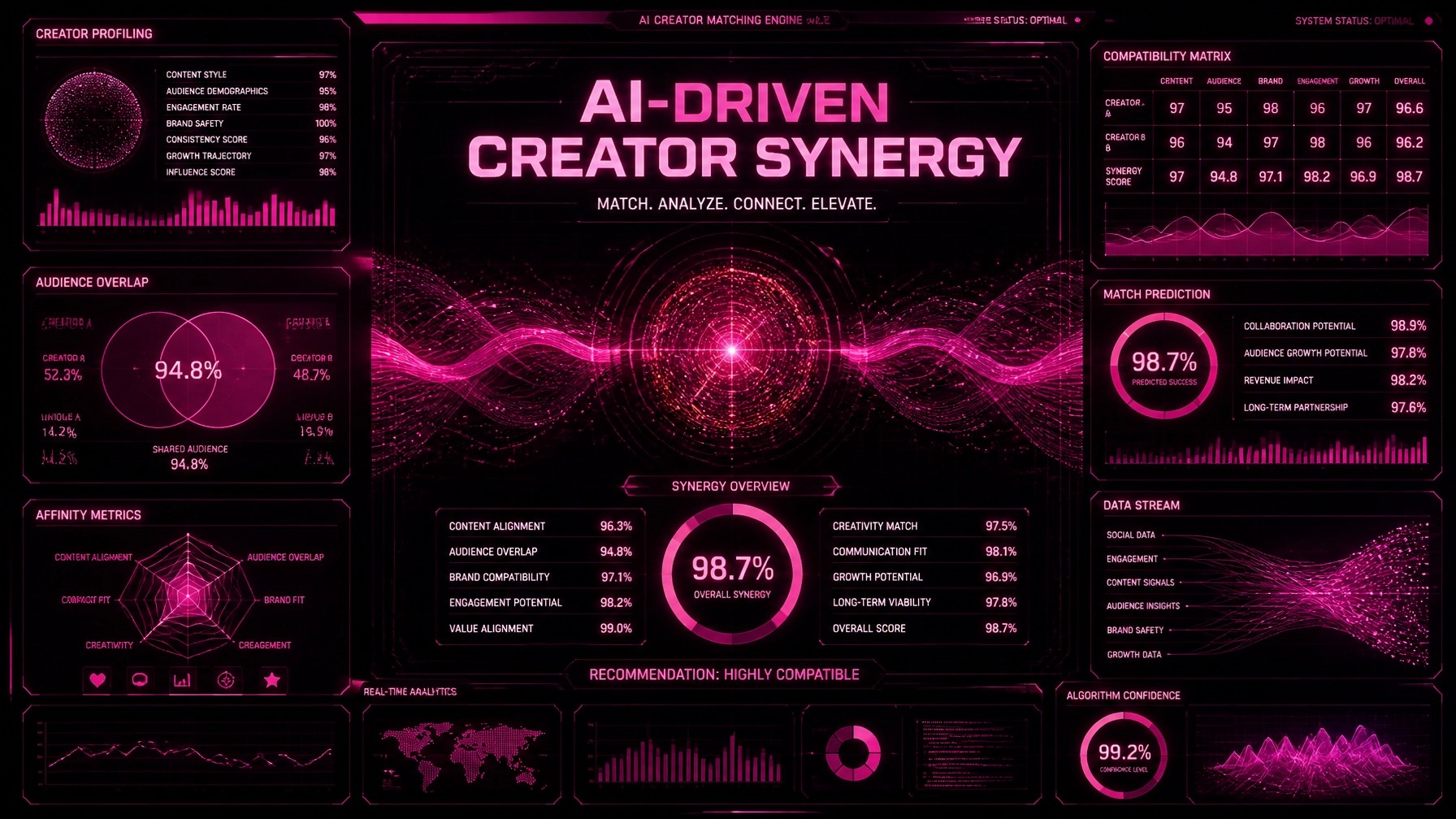
The reason the game has changed in 2026 is the introduction of two specific AI-driven tools that bridge the gap between "influence" and "performance."
1. Gemini-Powered AI Creator-Matching
The days of manual outreach and vibes-based creator selection are over. YouTube's new AI matching engine now analyses massive pools of creators using behavioural, contextual, and conversion signals, not just follower counts or engagement percentages.
In practice, Gemini-powered creator-matching helps with:
- Audience fit: finding creators whose viewers behave more like your best customers.
- Message fit: matching creator styles to specific offers, objections, and product categories.
- Intent fit: identifying content environments where future conversion probability is higher.
- Creative fit: figuring out whether tutorial content, testimonials, comparisons, unboxings, or problem-solution angles are more likely to create downstream sales.
By using AI-matched creators for your creative strategy, you are no longer guessing who will resonate. You are deploying content with a stronger statistical chance of driving assisted conversions, branded search lift, and higher-quality retargeting pools than standard brand-led ads. This connects directly to the AI-powered analysis approach we use across all channels.
2. Journey-Aware Bidding
Traditional bidding looked at a single session or a narrow conversion event. Journey-Aware Bidding looks at the broader sequence of interactions that lead to purchase. The algorithm now understands that a user who watches 45 seconds of a creator's unboxing video on YouTube may be significantly more likely to convert later after seeing a Performance Max ad, a branded Search ad, or a Meta retargeting Reel.
What Journey-Aware Bidding changes operationally:
- View quality matters more than raw reach. Watch time, engagement depth, audience fit, and content relevance now matter more because they correlate with downstream action.
- Cross-channel conversion probability matters more than direct click data.
- Creative sequencing matters. A creator-led explainer on YouTube can warm the audience. A Shopping or Search ad can capture intent. A Meta remarketing ad can close the loop.
- Measurement has to mature. If your business only checks one platform's reported ROAS, you will miss the reason the system is working.
The Multi-Channel Wingman Strategy
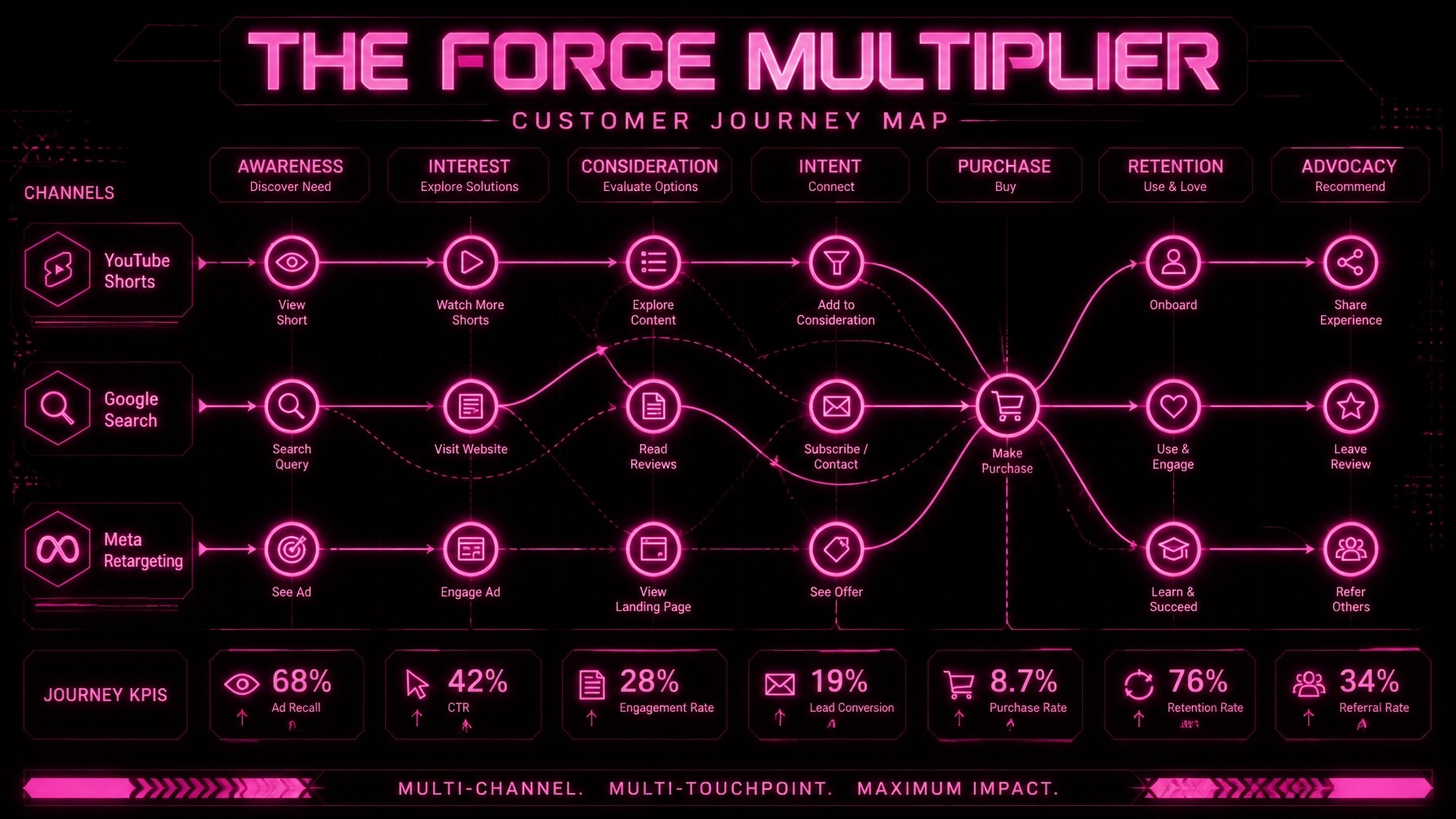
The goal is not to force YouTube to be your only sales machine. The goal is to use YouTube to make your other channels more efficient. Think of it like this:
- YouTube creates familiarity
- Google Search captures intent
- Google Shopping and Performance Max convert product-aware users
- Meta retargeting closes hesitation
- Meta prospecting reinforces attention and repeats the message
When these channels are linked properly, the whole account gets stronger. When they are run in silos, you get patchy attribution and inconsistent ROAS.
Step 1: Use creators for the hook, not the hard sell
People go to YouTube to be entertained or educated, not to be sold at immediately. Use AI-matched creators to produce product demos, unboxings, comparison videos, "here is how I use it" content, problem-solution explainers, and objection-handling content. This content does not need to ram an offer down someone's throat. Its job is to lower resistance and build trust.
Step 2: Synchronise with Search and Shopping
When someone watches your YouTube content, their search behaviour changes. They stop searching generic category terms and start searching your brand, product line, or specific problem-solution phrase. That means your Google Ads strategy has to be ready to catch the demand YouTube creates. At minimum, you need branded Search campaigns protected, Shopping fed with a clean product feed, and landing pages that match the message from the video.
Step 3: Use YouTube to improve Meta efficiency
YouTube often warms people up before they ever engage with Meta. Once someone has seen your product in action, your Meta retargeting has a much easier job because Meta is no longer introducing the brand from scratch. It is reminding, reinforcing, and nudging. That usually means stronger click-through rates, faster conversion of colder audiences, and better performance on direct-response offers.
Step 4: Build the halo effect intentionally
YouTube should be the top-of-funnel engine that feeds your Meta and Google retargeting lists. By using engagement data from video ads, site visits, and viewed content themes, you can create more specific follow-up sequences that move buyers from curiosity to conversion.
The Leeshless Loop: A Framework for Demand Generation and Capture
Think in terms of a loop instead of a funnel. Real buyers bounce around, compare, forget, come back, and convert when enough trust and urgency stack up.
- Spark demand: Use YouTube creator content and video prospecting to introduce the product, frame the problem, and give the brand a face and voice.
- Capture intent: Once demand is sparked, capture it with branded Search, non-branded Search, Shopping ads, Performance Max, and strong product pages.
- Reinforce consideration: Use Meta retargeting and repeat YouTube exposures to answer objections, show proof, and create urgency.
- Convert and measure properly: Look at actual business impact. That means watching account-wide MER, New Customer MER (aMER), new customer revenue, branded search lift, retargeting efficiency, and CPA trends.
- Feed the loop back into creative and bidding: Once you know which creators, hooks, audiences, and products lift downstream sales, feed that back into your creative pipeline and channel allocation.
Practical Steps for Ecommerce Brands Doing $10k to $250k+/Month
- Stop judging YouTube like branded Search. Judge it on new traffic quality, branded search lift, assisted revenue trends, and account-wide MER stability.
- Start small, but not randomly. Make sure your Search, Shopping/PMax, and Meta retargeting are already functional before adding YouTube spend.
- Pick one hero product or offer. Start with your best-selling product, the one with the clearest problem-solution fit and the strongest social proof.
- Build creator content around objections. Brief creators around specific buying barriers rather than generic brand messages.
- Make sure Search is ready for the demand spike. Check that branded campaigns are live, your feed is clean, and product pages load fast.
- Tighten Meta retargeting. Build follow-up ads for site visitors from video campaigns, product viewers, cart abandoners, and engaged social users.
- Measure with business metrics, not platform ego. If branded search is climbing, Meta retargeting gets cheaper, and total revenue rises, the system may be working exactly as intended.
- Cut losers fast, scale winners harder. Kill weak creator partnerships fast, cut low-retention videos, and double down on creators and concepts that lift assisted conversion and branded demand.
Stop Guessing. Start Scaling.
YouTube in 2026 is a powerhouse for ecommerce, but only if you use it properly. YouTube creates demand. Search and Shopping capture it. Meta reinforces and closes it. MER and New Customer MER tell you whether the whole machine is healthy.
At Off Leesh, we do not just run ads. We build an ecosystem where every dollar spent on YouTube is measured against what it does for Search, Shopping, PMax, Meta, and the overall health of the account. We have generated millions in revenue for our clients with an average 4.8x ROAS across all channels.
We only work with brands we know we can scale. If you are doing $10k to $250k+ a month and you are ready for a transparent, results-focused partnership, let us talk. Book a free account audit and strategy session with the Off Leesh team today.
Want results like this for your brand?
We run Google and Meta ads for ecommerce brands doing $10k–$250k+/month. Month-to-month, no lock-in, direct access to your strategist.